The bayberry and mine tells
Systemic Crises in Public Safety and Grassroots Governance in Transitional Economies: The Political and Economic Logic from Food Safety Failures to Industrial Accidents
In recent years, a series of major public safety crises have repeatedly shaken transitional societies, demonstrating systemic failures across food safety and industrial production. From early infant formula contamination scandals to heavy-metal contaminated grain , defective personal care products , toxic chemical contamination of edible oils during bulk transport , industrial wastewater discharged into irrigation channels , chemical preservation of fresh fruits , and catastrophic underground gas explosions claiming dozens of lives —these events are far from isolated. Rather, they reveal a profound political-economic pathology.
These crises are not merely technical failures or random accidents. Instead, they represent the concentrated expression of structural fractures within a transitional political economy. In an environment defined by deep societal cynicism where laws are often treated as mere suggestions ("I have the law, you have a laugh"), rigid statutory boundaries yield to informal patron-client networks. Private capital, operating under a state of "willful blindness" from regulators, maximizes profit by externalizing environmental and safety costs. When economic growth slows and fiscal constraints tighten, these very same capitalists and rent-seeking officials are targeted as "fattened pigs" ready to be harvested to plug local fiscal deficits. Meanwhile, the working class and general public are left with neither a basic standard of living nor basic safety guarantees.
Historical Echoes: The Generational Evolution and Shared Origin of Public Safety Crises
An analysis of public safety crises over the past two decades reveals a clear evolution from "direct adulteration of production inputs" to "systemic supply chain breakdown." In the early phases of rapid industrialization, crises primarily manifested as the direct contamination of basic production inputs. For instance, the unrestricted discharge of metallurgy and chemical wastewater heavily contaminated irrigation networks and agricultural soils, directly leading to heavy-metal contaminated grain and toxic agricultural runoff crises. This early period was characterized by localized, acute chemical and physical damage to the natural ecosystem.
As specialized division of labor deepened and supply chains became infinitely elongated, public safety crises transitioned into systemic, cross-industry, and cross-regional failures. The scandal involving chemical transport tankers carrying bulk edible oil shipments without prior cleaning represents the peak of this systemic failure. Transporters routinely hauled industrial coal-to-liquid chemical products and subsequently loaded bulk food-grade vegetable oils without performing any tank sanitization. This practice of mixing hazardous industrial agents with foundational dietary staples was an open secret within the transport logistics industry.
Recently, this same contamination logic has permeated agricultural and consumer goods industries. Investigations into fresh produce supply chains revealed that wholesalers systematically immersed fresh stone fruits in unapproved preservation chemicals and artificial sweeteners (such as dehydroacetic acid and sodium cyclamate) to artificially extend shelf life and enhance appearance for long-distance logistics. This practice operated within established regional networks, where agricultural supply stores openly sold unlabelled chemical additives and local regulatory offices remained completely oblivious. Similarly, in the personal care sector, major consumer hygiene brands faced massive public backlashes after investigations confirmed they were systematically producing undersized absorption layers in feminine products, utilizing lenient national tolerance margins to reduce material costs.
While these crises span diverse sectors—agriculture, logistics, and consumer goods—they share a deeply rooted common pathology: capital systematically sacrifices safety standards to maintain marginal profitability, while regulatory agencies, driven by local protectionism and rent-seeking interests, choose selective blindness.
"The Law is a Joke": Decimation of the Rule of Law by Informal Power Networks
The popular cynical phrase "I have the law, you have a laugh" captures the massive chasm between written statutory frameworks and actual enforcement realities in transitional societies. On paper, the statutory provisions of food safety and occupational health acts are incredibly strict, carrying severe administrative, civil, and criminal liabilities. However, in daily practice, these formal legal structures are systematically hollowed out by informal power dynamics.
The Mechanism of Patronage and "String-Pulling"
In local administrative enforcement, the rigidity of formal law is routinely melted down by personal patronage networks and state-business alliances. When private enterprises face environmental, safety, or product inspections, their primary defensive strategy is rarely to invest in compliance. Instead, they mobilize private networks to leverage higher-ranking officials or enforcement personnel to "pull strings" and "call in favors." This informal mechanism not only downgrades severe infractions into trivial administrative warnings but also allows regulatory standards to be customized for specific firms. Under this ecological dynamic, strict compliance becomes a competitive disadvantage, while firms that master patronage networks enjoy massive systemic arbitrage opportunities.
"Willful Blindness" as a Rational Bureaucratic Choice
For local regulatory agencies, maintaining a state of "willful blindness" toward widespread industry non-compliance is a highly rational political decision. Local administrations rely heavily on private firms to generate tax revenue, support employment, and meet macroeconomic performance targets. If regulators were to strictly enforce food safety and occupational hazard laws, thousands of small and medium enterprises would go bankrupt due to prohibitive compliance costs, precipitating local unemployment and economic stagnation.
Consequently, a tacit contract is forged between regulators and capital: firms operate in gray areas to maintain margins, while regulators conduct superficial, scheduled, or pre-announced inspections to maintain the political illusion of compliance. It is only when these "open secrets" are exposed by independent investigative media and trigger massive public outrages that local administrations pivot to "campaign-style" enforcement—shutting down factories, destroying inventory, and detaining executives. This erratic swing between absolute laissez-faire and sudden draconian crackdowns completely degrades the predictability and authority of the rule of law.
The "Fattened Pig" Hypothesis: Fiscal Reshaping and Capital Harvest in Economic Downturns
When analyzed from a macro political-economic perspective, a more tragic, cyclical mechanism emerges: the "Fattened Pig" hypothesis. This framework explains why capital and corrupt bureaucrats are allowed to amass illicit wealth during certain periods, only to face devastating crackdowns in others.
The "Fattening" Phase during Economic Booms
During periods of high economic growth, local governments prioritize GDP expansion and investment attraction. In this phase, they provide private capital with soft regulatory environments and implicit subsidies. Regulatory "willful blindness" essentially serves as an unwritten state subsidy to private firms. Under near-zero environmental and safety compliance costs, private capital expands rapidly like a hormonally enhanced pig. Simultaneously, grassroots officials who facilitate this regulatory arbitrage amass significant illicit wealth through rent-seeking and private stakes.
The "Harvesting" Phase during Economic Downturns
However, when economic growth stagnates, and local administrations face severe fiscal crunches—often exacerbated by real estate recessions and the collapse of land-leasing revenues—traditional tax models fail to cover massive public expenditures. To open new non-tax revenue channels and offset mounting fiscal pressures, the state's strategy undergoes a fundamental shift: from encouraging capital expansion to harvesting accumulated capital.
Private capitalists and corrupt bureaucrats who accumulated fortunes in the regulatory gray zones, laden with historical non-compliance liabilities, suddenly become ideal targets for fiscal harvesting. The state initiates sweeping compliance audits, environmental crackdowns, safety drives, or anti-corruption campaigns to systematically extract these assets. This behavior can be modeled using a simplified payoff function for local administrations:
$$Y=T(C)+F(C)-G(C)$$
Where:
$Y$ represents the total fiscal and political payoff of the local administration.
$C$ represents the degree of non-compliance or gray-area activity permitted for capital.
$T(C)$ represents normal tax revenues, which may rise as compliance costs fall, increasing corporate profitability.
$F(C)$ represents non-tax revenues generated from administrative fines, asset forfeitures, and anti-corruption confiscations (the "harvest bonus").
$G(C)$ represents governance risk, social costs, political liability, and public outrage stemming from accidents or toxic exposures.
During economic upswings, normal tax revenues $T(C)$ are robust, and the state's tolerance for safety and environmental risks is relatively high ($G(C)$ is weighted lightly). The optimal state strategy is to keep enforcement low, letting $C$ remain high, effectively "fattening the pig."
During economic downturns, tax revenues $T(C)$ collapse, and fiscal deficits widen. The state's tolerance for catastrophic safety accidents or social unrest drops to near-zero ($G(C)$ is weighted extremely heavily). Simultaneously, the demand for non-tax revenues $F(C)$ skyrockets. The state's optimal strategy shifts immediately to "harvesting"—imposing massive fines, seizing assets, and prosecuting non-compliant actors to rapidly replenish fiscal coffers.
The Externalization of Costs onto the Working Class
The most brutal aspect of this cycle is that the working class and general public bear the costs of both phases:
During the "Fattening" Phase: Capitalists and corrupt officials squeeze marginal profits by cutting safety budgets, dumping toxic wastewater, and using illegal chemical additives. The public, as workers and consumers, pays with their health, safety, and lives.
During the "Harvesting" Phase: Although the state collects millions in fines and forfeitures , these funds are almost exclusively directed to plug local debt gaps, pay public sector salaries, or maintain administrative operations. They are rarely converted into public compensation funds, consumer protection programs, or occupational health safety nets. The "pig" is slaughtered and the treasury is replenished, but the public's dinner plates remain contaminated and workers must still risk their lives in hazardous conditions.
The Logic of Resistance: "Justice by Outcry" and the Stability Trap
In a system where formal judicial and administrative relief channels are structurally blocked, the marginalized public does not remain entirely passive. However, lacking independent unions, consumer associations, or formal civil society groups, citizens must resort to a highly informal, volatile form of resistance: "Remedy Allocation Based on Public Outcry" (commonly known as "Justice by Outcry").
The Game Theory of "Justice by Outcry"
In a standard legal framework, an individual consumer or worker seeking compensation for food poisoning or a workplace injury faces insurmountable barriers: prohibitive legal costs, information asymmetry, and a local judicial system protective of tax-paying businesses. Recognizing that formal litigation is a dead end, victims quickly realize their only leverage is to manufacture "social instability" to transform a private civil dispute into a political crisis.
By staging public protests, blocking transport lines, gathering in front of administrative buildings, or engineering viral social media outcries, victims exploit the primary vulnerability of local officials: their intense fear of administrative demerits under centralized stability-preservation mandates. Faced with imminent threats to their political careers, local officials often bypass formal legal processes, coercing the offending business into a settlement or directly utilizing public welfare/stability funds to issue shut-up-money payouts to quiet the protesters.
The Self-Destruction of the Stability Paradigm
While this mechanism occasionally delivers immediate compensation to highly vocal victims, it severely undermines long-term social governance:
It penalizes peaceful, law-abiding citizens while rewarding aggressive, disruptive behavior, accelerating the perception that "the law is a joke".
By forcing local administrations into transactional compromises to buy short-term peace, it rapidly depletes local fiscal reserves, entrenches public distrust, and makes subsequent social conflicts increasingly explosive.
Capital Exploitation and the Cost of Life: A Micro-Study of the 2026 Coal Mine Disaster
While food safety failures represent an incremental, invisible erosion of public health, the catastrophic underground gas explosion in May 2026 at a major private coal mine—which killed 90 miners and injured 123 others—serves as a stark example of capital directly consuming human life under regulatory capture.
The tragedy of the 2026 coal mine disaster lies in the fact that every single regulatory safety boundary was systematically breached. From superficial administrative fines to blatant fraud regarding underground blueprints and worker safety tracking, the mine operators treated safety statutes as negligible paperwork. When the catastrophic explosion occurred, high-profile investigations and the detention of executives could not undo the reality that the safety of the working class had been traded for corporate profit during years of normal operation.
Conclusion: The Self-Reinforcing Governance Trap
By synthesizing these elements, we can map the closed feedback loop of public safety and grassroots governance crises in transitional economies:
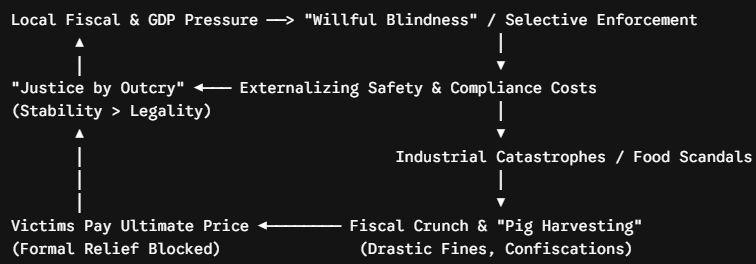
This cycle explains why, despite frequent amendments to safety and food regulations , severe systemic public safety incidents continue to repeat.
Under this framework, the state-business nexus maximizes gray-area profits during periods of economic expansion, feeding local bureaucratic and economic needs. When the economy slows or fiscal pressures mount, the state utilizes anti-corruption or compliance crackdowns to harvest these accumulated private assets. While these campaigns present an image of decisive state action and the rule of law, they represent a retroactive extraction of wealth to support state finances rather than a proactive, preventative system to protect society.
The public remains trapped at the bottom of this loop, suffering the bodily harm of contaminated food and dangerous workplaces during the "fattening" phase, while enjoying none of the financial recoveries during the "harvesting" phase. Left with no formal avenues for legal or administrative recourse, they are forced to rely on disruptive protests to demand ad-hoc compensation, cementing a governance model where stability takes precedence over legality, and the rule of law remains a systemic impossibility.